Title Sequence…

My partner and I aren’t too experienced with making movies, but we knew that Deadpool had one of the greatest title sequences ever (for an action comedy a least)… However, it is difficult to ignore the fact that its extremely difficult to have a shot where everything is frozen in time as the camera moves around to cover the entire setting. But, remember as well as being a super talented and handsome stunt devil. I am also a creative genius (said no one ever). Therefore coming up with a way to implement this type of title sequence is going to be as simple as 1..2..3 (again said no one ever). Deadpool shows us how you can create a gruesome, super-violent action sequence seem like a gleeful sequence of unfortunate events. This is something we want to for sure take into account when we are creating this film. In addition to providing our film with the silly, freeze frame action sequences, we also want to implement the breaking of the fourth wall. This will reduce the seriousness of the context and provide a source comedic relief.

In addition to taking some aspects from the movie Deadpool, we want to implement some aspects of the action comedy film Guardians of the Galaxy. We would do this by inserting a sort of background of the character. Possibly showing his previous stressors or a couple days before. Maybe the office worker being assigned a huge assignment. This will give the audience a sense of mystery and suspense. Not knowing what is actually happening or what may happen. Like the title sequence of Guardians of the Galaxy, the main character will be partaking in the task which he was assigned and getting madly invested. Almost to the point where he will want to break and stop everything. However, as this all occurs the music in the background will not correspond to the things happening. It will be happy and upbeat, whereas the typical corresponding music should be angry and stressful. This will again, create a sense of comedic relief and not like a suspenseful, serious movie.

Story Boarding…

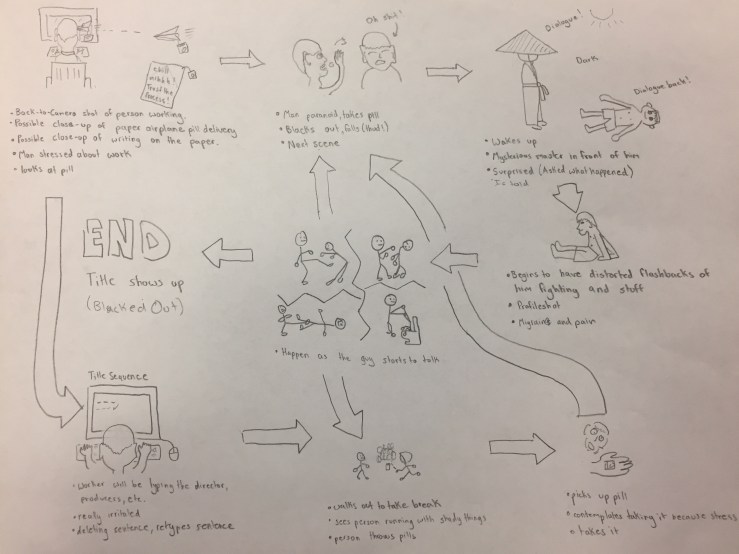
Well, well, well… A storyboard huh. To be honest I was really excited when we were assigned to do a storyboard. Not because we were starting the movie… Nah. But because it was time to doodle. Drawing is a passion of mine since I was small, and having the knowledge that the doodles I will be drawing are going to be coming to life is great. Well enough with this, let me tell you about what this storyboard is really about. At first, my partner and I were hesitant about choosing what route to go in with the film. But as many ideas came and left… one of them stuck with us. We wanted it to symbolize the idea that the movie Hangover was trying to show. Rather in a less vulgar and adult-like manner. We wanted to make a movie where a person tries to recover all the lost memories which occurred whilst under the influence of an unknown substance. However, due to our love for action comedies, we had to implement this aspect into an action comedy film. This was really simple, to be honest. I am a world class stunt devil don’t forget. Nah but in all seriousness, we wanted to start the film with a typical stressed office worker, sort of like Wasted. However, we wanted an exotic way of delivering the drug to the innocent office worker. This is when we thought of the idea of a random paper airplane hitting the office worker working overtime in an empty office. We also came up with an alternative beginning where the office worker was too stressed to do any more of his work, therefore decided to go take a little break. This is where he is confronted with an issue regarding a shady individual running from other people. This individual then tosses an unorthodox pill into the bush right next to him. Out of curiosity and stress, the man then takes it. In both beginnings. The beginning then leads to crazy action filled events that seem to look like flashbacks or blurring visions. However, before the worker can actually accumulate the visions and make a decent assumption on what was happening he blacks out. He wakes up in a shady garage with a random guy dressed like a karate master. This is when he is told of the occurrences that happened during his “trip”.

**UPDATE**

The story has taken a little shift especially in the sense of the order of the events.

Target Audience…

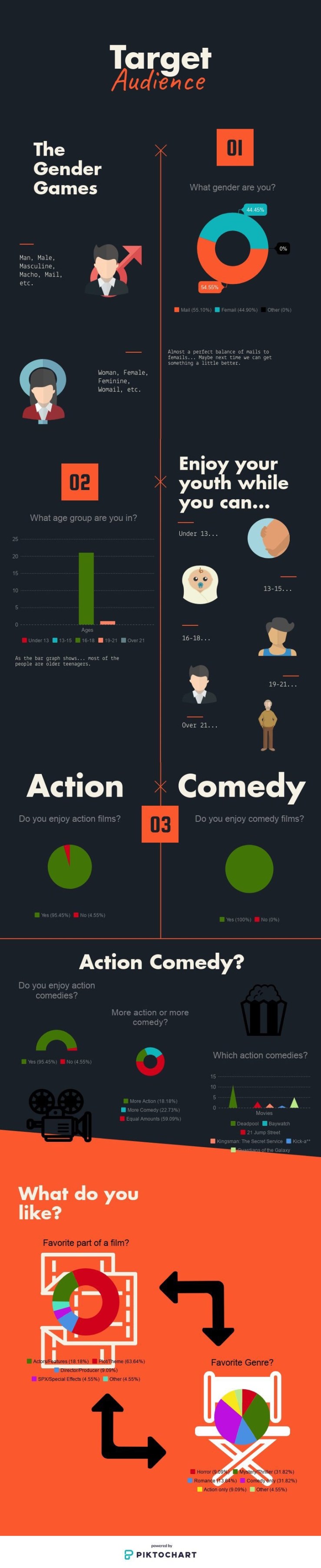
My partner and I believed it would be best to target our film to the younger crowd. Mostly due to the fact that we know what “we” enjoy. It would have been weird trying to create a movie for babies or worse… THE ELDERLY. No offense to them, it’s just we don’t really know what they like To watch. So to ensure that people enjoy and appreciate our ridiculous humor and obnoxious comments we made sure to target this film to the teenagers of the world. In order to ensure that our genre of action comedy would be a big hit for this target audience, we created a survey with questions relating to action comedies. For example, “Do you enjoy comedy films?”, “Do you enjoy action films?”, “Do you enjoy action comedy films?”, etc. This will show us whether or not our target audience is actually into watching action comedies. We evidently got outstanding feedback. Our target audience was invested and ready for the “dynamic duo” to create an intro to an action comedy. In the survey we also asked what they’re favorite action comedy film was to see what aspects we should include in the intro. The people really enjoyed Deadpool over all the other films, so we knew that we had to include the breaking of the 4th wall, and heavy amounts of action mixed with enough comedy. Another critical result we have obtained is the other genres the like (other than action comedy). People stated that that they liked mysterious and thrillers. With this we can include some aspects of this genre to further invest and entertain the audience with something they enjoy watching.

Brainstorming…

As the class proceeded, we began to be introduced to the final project. We were tasked with creating a short introduction of a film. At first, I was kind of worried because this is something I’ve never done. But then… I realized that we had already done something like this before (multiple times). So then I became less worried.

My partner and I started to talk about how fun this is going to be and the different silly ideas we had. SILLY… with this the inspiration of our entire project. I was headstrong about making a comedy, but of course my partner was an action type of dude. So we made a compromise and chose to base our film of the genre known as ACTION COMEDY. Best displayed by Deadpool, 21 Jump Street, Kick a**, and many more. Our budgeting would be cheap because I am a world class stunt devil and my partner is a muscular white guy (joking). My partner and I really enjoyed films like these so we decided that it would be best to chose something we’d enjoy replicating in our own creative way.

Still Struggling…

I recently learned about composition… And “wow” what a struggle it was. To begin with, I was unaware that there was still more to learn about film. But to my surprise, there was (sort of sarcasm). It seemed like creating a film was something that never ended… It began with mise-en-scene, lighting, shot scales, and many more. But now one of the most confusing parts of film creation, composition (at least for me). The composition of a film includes many different aspects. But revolves mainly around the idea of the frame of the image and the elements of the mise-en-scene which appear in it. For example, one of the more difficult aspects to understand was the idea of the “Rule of Thirds.” Obviously, not the actual concept of splitting the screen into three imaginary sections horizontally and vertically and placing the main subject of the image in the intersections, but the importance of it. As a person who was never interested in photography, I never realized the difference between a centralized image compared to one following the rule of thirds. However, with the help of my teacher, it is starting to clear up. I am beginning to understand the importance of character placement/ positioning and the different effects which they provide. However, other than that I am pretty secure when it comes to character proxemics and staging positions. For example, character proxemics includes intimate distance, personal distance, social distance, and public distance. Each distance places a certain amount of space between the subjects. Starting from touching to almost 20 feet away. And staging positioning includes full-front, quarter turn, profile, three-quarter turn, and back to the camera. The different staging positions provide different amounts of intimacy with the audience which assists in creating a familiar environment with the people watching, as well as providing the audience with a sense of realism. In addition to these aspects, the composition also includes shot scale, density, contrast, framing, form, etc. All these aspects work together to develop the overall composition of the film. As for contrast, there are dominant contrasts which refer to the first thing you see in an image and subsidiary contrasts which is the second thing you see in an image. Density is dependent on the amount of visual information is being displayed. And form and framing refer to the setting and the staging positioning of the characters. For example, framing refers to the looseness or tightness of the frame. Whether the people have enough space to move without disappearing out of the frame. Whereas form refers to open or closed. This is more of the setting in the actual scene. Whether the setting is cluttered and gives the subjects no room to roam or the subjects are in open areas and are free to roam.

I bet you thought I was done… but we still have shapes and lines, density, balance, depth, lead space, aspect ratio, and shot scale. You may be thinking how in the word can a shape be used to create meaning. Well, shapes can create balance and unity in a frame, as well as create symbolism throughout the film. Lines can create visual motion by directing your eyes to the importance of the scene. The density of a scene refers to the amount of visual information that is being provided. Depth is the how the background and foreground affect the scene. Lead space or lead room is the room/ space given to a person depending on the direction they may be staring at. Lead room provides a comfortable framing because it doesn’t seem as if the character is staring at the edge of the frame. Aspect ratio refers to the horizontal and vertical sides of the frame and there relation to one another and the screen they are placed on.

All in all, the composition refers to the mise-en-scene’s elements and how they affect the film.

My first taste of the struggle…

My group and I were tasked with creating a scene in three shots. This was honestly my first taste of what directors, editors, actors, and anyone who works in the film industry go through to create a film. It was not pretty… but we got it done and it came out semi-decent. The activity which should have taken one class took us two. This was when I first realized that making a film was not easy nor fast. It is a slow and painful process that will lead to, hopefully, success.

First, we began brainstorming about what we wanted the basis of our scene to be. This is when we came up with various ideas all having to deal with comedy. This is when we came up with the idea of a blind person walking into the wrong area at the wrong time without supervision. And the effect of being on your phone and being unaware of your surroundings, especially when you are tasked with taking care of a person. With these ideas in mind, we worked on the storyline of the scene. The scene will begin with the blind man sitting impatiently with his caretaker. The caretaker will not be paying attention to the blind mam rather be paying attention to his phone. This is when the blind man decides to get up and leave. However, rather than leaving through the safe exit he enters a dangerous area. Only when the blind man slams the door and is far from him does the caretaker realize that he has entered a dangerous area and chases him into the restricted zone. As the blind man gingerly walks through the dangerous hallway, the caretaker is forced to run and hope to save him. This is when a flying bag comes out of nowhere and is about to strike the blind man. However, the caretaker takes the hit whilst the blind man continues walking. As the scene continues the blind man remains untouched while the caretaker is recovering from the tremendous hit he took for the blind man. When suddenly, some flying notebooks appear from nowhere. However, the blind man luckily bent over to tie his shoelaces dodging the books. the blind man dodging the books caused them to strike the downed caretaker instead. The following shot shows the blind man still untouched and gingerly walking. However, there is one more dangerous obstacle that he must conquer to exit safely. This was a power line stretching the length of the hallway. Again, the blind man safely cleared it and continued walking.

To create this scene we used a mixture of mainly over the shoulder shots, two shots, close-ups, and medium shots to create tension and suspense, as well as allowing the audience to experience the scene with the protagonist. The over the shoulder shot allows us to show the audience what the protagonist will be walking into and feel as if they are following him in real time. The close-up shots allowed the audience to determine the emotions of both the blind man and the caretaker without having to directly tell them through dialogue. The medium shots allowed us to show body language and expressions without showing the distracting background, forcing the audience to focus on the subject. And the two shot allows us to set the scene and show the connection between the two subjects.

My minimal knowledge of the field of film…

To be honest, when I first entered the class I had taunted my friend with a “How hard can this be?” Little did I know it took lots of time and effort to create even a semi-decent film. The amount of patience and persistence needed to produce a film is immense. It is almost unbelievable. But it’s not… Now that I have gone behind the curtain and visualized what actually occurs, it is easy to believe that a good film can take years to perfect. As of current, it has felt as if we have covered several months’ worth of material, but in reality, we have just started. We have learned about many different aspects which affect a film’s tone, mood, and the film overall, other than the actual dialogue. These aspects include mise-en-scene, camera angles, and camera distances. I am aware that there are many more aspects, however, these are the ones we have learned so far. I won’t bore you with a bunch of specific details, but I will tell you how each aspect independently affects a specific scene.

Right now you may be asking yourself… “What in the world is Mise-en-scene?” Well, mise-en-scene is “the arrangement of scenery and stage properties in a play” or “the setting or surroundings of an event or action.” All in all, mise-en-scene is the “visual theme” of a specific scene.

Now you may be wondering, how does filming a scene from different angles create emotion or tone? This is when I jump in and say “because it does.” I’m just kidding… however, in order for me to explain you must first learn about the different camera angles themselves. Firstly, there is the eye level angle. This angle is practically someone staring at you right in the eye, And it is done by pointing the camera straight ahead. Secondly, we have a low angle. This angle is basically how short people normally look at tall people. Therefore, the camera is pointed up from a lower angle. Thirdly, there is the opposite of low angle… can you guess? The high angle is basically how tall people look at short people. Therefore the camera points down from a higher angle. Then there is the dutch angle or tilted angle. And then the over the shoulder which really isn’t a proper angle but was put into this category anyway. Alright now, that we got that stuff out of the way I will quickly explain the meanings they carry. The reason for using an eye-level angle is mainly to remain objective. The low angle creates a sense of domination. It causes the subject to seem dominant and superior to the others. The high angle creates a sense of inferiority. Forces the subject to seem small and inferior. The dutch angle or tilt creates a sense of unbalance. This angle can be used to show how the scene/ subject is uneasy or create tension in the scene. And the over the shoulder “angle” isn’t really used to show emotion. It is more so for following the subject or giving the audience the ability to feel as if we are actually in the scene looking at what the subject is looking.

Then there was one. Camera distance does not really give the scene emotion or tone. Rather, it helps us with understanding the subject’s feelings and the overall setting. For example, the close-up shows the audience the subjects facial expressions allowing us to determine what the subject is going through. Then there is the extreme close-up, which is usually used to highlight or emphasize the subject’s eyes or mouth. Zooming out a little father will lead you into a medium shot. This is used to show about half the person which allows the audience to see the subjects body language, whilst eliminating the distracting background. Zooming out further will get you into a long shot which adds location to the subject and scene. And the extreme long shot focuses more on the location rather than the actual subject.


About me…

Well… I honestly never thought I would be doing this type of thing, but here I am. My name is Eric Joa and I’m a Cambridge student at G. Holmes Braddock Senior High. I’m currently a student athlete competing in the “great sport” of American Football, while maintaining a decent GPA. That’s probably one of my greatest accomplishments, other than convincing myself that I can possibly like film and enjoy the study of media. I’m just kidding, it didn’t take too much convincing… just another go at watching “Up” without crying. But in all seriousness my interest in this class came from my curiosity on how a film, something I know is fake, can possibly capture so much emotion and emphasis on imaginary characters.